Trigger finger can significantly affect your daily life, making it difficult to perform routine tasks like gripping a pen, a utensil, or even your smartphone. If you live with this restrictive and painful condition, treating and relieving your symptoms is vital.
At Modern Orthopaedics of New Jersey, we tailor trigger finger treatment to the specific needs and goals of each patient – with conservative (non-surgical) treatment solutions as the starting point. In this article, we’ve provided an overview of trigger finger and explored 7 proven exercises that can help alleviate its symptoms.
Ready to learn more about trigger finger and receive a personalized treatment plan from our award-winning specialists? Contact us at Modern Orthopaedics of New Jersey today to schedule an initial consultation!
Table Of Contents
- What Is Trigger Finger?
- Who’s At Risk And When To See A Pro
- Warm-Up, Rest, And How To Avoid Flare-Ups In The Affected Finger
- The 7 Best Trigger Finger Exercises (Step-By-Step, With Tips)
- Sets, Reps, And Frequency
- Other Treatments For Trigger Finger
What Is Trigger Finger (Stenosing Tenosynovitis)?
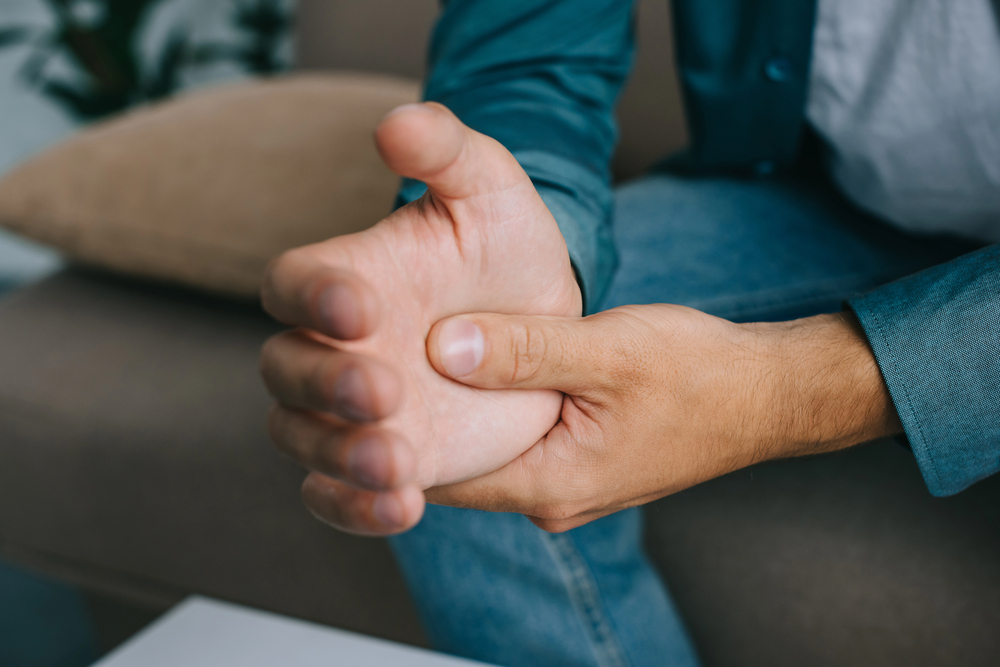
Trigger finger (stenosing tenosynovitis) is a condition caused by irritation and/or inflammation of the tendons responsible for movement in the fingers or thumb. It’s typically characterized by a popping or clicking sound – like a trigger being released – when the affected finger or thumb is bent or straightened.
Causes Of Trigger Finger
Trigger finger is often caused by overuse, repetitive hand movements, or injury to the hand. It can also be associated with chronic health conditions like arthritis, diabetes, or gout.
Symptoms Of Trigger Finger
Common symptoms of trigger finger include:
- Finger/thumb locking or catching and then snapping straight, often accompanied by an audible click or pop
- Pain and tenderness, especially at the base of the affected finger or thumb
- Stiffness and/or swelling that makes moving the affected finger or thumb difficult
- A lump or nodule at the base of the affected finger or thumb
- Difficulty gripping objects
Who’s At Risk And When To See A Pro
Trigger finger has a prevalence in approximately 3% in the general population, but your risk may be higher if:
- You have arthritis, diabetes, or gout
- You’re female
- You’re over the age of 60
- Your job requires extensive gripping or hand flexion
You should consider having your trigger finger symptoms evaluated by an orthopedic specialist if they’re severe, ongoing, and/or affecting your quality of life. At Modern Orthopaedics of New Jersey, our board-certified team is committed to helping you get back to all the things you love the most as quickly as possible!
Warm-Up, Rest, And How To Avoid Flare-Ups In The Affected Finger
Just like bigger joints in the body, finger and thumb joints benefit from a proper warm-up before activity and sufficient rest afterward. Gentle stretches can also go a long way in managing trigger finger symptoms – and avoiding major flare-ups.
Here are a few simple techniques to try implementing:
- Gentle Stretching Exercises – Before engaging in activities that involve the hand and fingers, take the time to do a few simple stretches like slowly opening and closing the hand a few times or stretching and holding the fingers apart for a few seconds.
- Warm Compress – Apply a warm compress to the affected hand to help relax tendons and muscles before activity.
- Limit Hand Use – Avoid using the affected hand as much as possible for a few days to allow for inflammation and irritation to decrease. Wearing a splint to keep the affected finger or thumb in a neutral position at night may also be helpful.
- Avoid Sudden Movements – Move the affected finger or thumb slowly and gradually whenever possible to help prevent locking and further irritation to the tendon.
The 7 Best Trigger Finger Exercises (Step-By-Step, With Tips)
At Modern Orthopaedics of New Jersey, we often recommend the following 7 finger exercises to alleviate trigger finger symptoms. As with any exercise program, it’s essential to get clearance from your doctor or orthopedic specialist before getting started. If there’s no improvement or your symptoms become aggravated by any of the exercises below, stop and contact your doctor or orthopedic specialist again for further evaluation.
1. Tendon Glides: Fingers Straight
This exercise helps to reduce stiffness and locking in the affected tendons:
- Start with all fingers fully extended and straight (palm can be down or up).
- Using slow, controlled movements, gently bend the tip joints of the fingers into a “hook” and then glide them back to a fully straight position.
Perform 2 to 3 sets of 5 to 10 repetitions 2 to 3 times per day.
2. Finger Lifts On A Flat Surface
This exercise helps to improve mobility and promote smooth tendon gliding in the hand:
- Start with your hands palm down on a flat surface, such as a desk or table. Ensure that fingers are fully extended and relaxed.
- Slowly lift one finger off the surface while keeping the other fingers flat. Hold for 2 to 3 seconds before lowering back down. Repeat one at a time with the other fingers and thumb.
Perform 2 to 3 sets of 10 to 15 repetitions per finger 2 to 3 times per day.
3. Rubber Band Extensions
This exercise strengthens the muscles responsible for extending the fingers and helps to prevent the catching or locking sensation characteristic of trigger finger:
- Place a light resistance rubber band (such as a hair tie) around the tips of all your fingers and thumb, keeping them relaxed and slightly bent.
- Slowly spread your fingers apart against the resistance of the band (including the affected one). Hold for 2 to 3 seconds and return to the starting position using carefully controlled movements.
Perform 2 to 3 sets of 10 to 15 repetitions 1 to 2 times per day.
4. Stress Ball Or Small Towel Squeezes
This exercise helps to strengthen the finger tendons while also improving grip strength and finger coordination:
- Hold a soft rubber stress ball or a small rolled-up towel (a washcloth works well) with your fingers wrapped around it, but relaxed.
- Squeeze the ball or towel as tightly as you can using your fingers and palm. Hold for 5 seconds before slowly releasing.
Perform 2 to 3 sets of 10 to 15 repetitions 1 to 2 times per day.
5. Passive Extension With Opposite Hand
This exercise helps to improve mobility and reduce stiffness in the affected finger:
- Rest the affected finger on a flat surface or your lap, keeping it relaxed and slightly bent.
- Using the opposite hand, gently grasp the affected finger at the middle or tip joint and carefully straighten it until it is fully extended.
- Hold for 5 to 10 seconds before gently releasing and returning to the starting position.
Perform 5 to 10 repetitions 2 to 3 times per day.
6. Fingertips Touch/”O-K” & Prayer Stretch
These stretches both help to improve flexibility and relieve tension in the hand and finger tendons:
Fingertips Touch/”O-K” Stretch
- Start with the hand in a relaxed position (palm up or down).
- Touch the tip of the thumb to the tip of the index finger, forming an “O” shape. Hold for 5 to 10 seconds.
- Still holding the “O” shape, slowly straighten the other fingers. Hold for 5 to 10 seconds before returning to the starting position.
Perform 2 to 3 sets of 5 to 10 repetitions 2 to 3 times per day.
Prayer Stretch
- Start with the palms together and fingers pointing upward – as if in prayer. Keep the elbows close to the body.
- Slowly lower the hands, keeping the palms pressed together, until you feel a gentle stretch through the fingers, palms, and wrists. Hold for 15 to 30 seconds.
Perform 2 to 3 repetitions 2 to 3 times per day.
7. Top-Joint Blocking
This exercise helps to improve flexibility/mobility and prevent locking in the middle joint of the affected finger:
- Start with the affected hand relaxed and the fingers in a slightly bent position.
- Using the opposite hand, gently “block” the middle joint of the affected finger by holding it in a bent position without allowing it to move or straighten.
- Straighten the isolated top joint of the affected finger and hold for 5 to 10 seconds before returning to a bent position.
Perform 2 to 3 sets of 5 to 10 repetitions 2 to 3 times per day.
Sets, Reps, And Frequency
General guidelines for sets, repetitions, and frequency are provided for each trigger finger exercise above. However, it’s important to tailor your trigger finger exercise routine to the specifics of your situation. Your doctor or orthopedic specialist may recommend beginning with fewer sets or reps and building up gradually over time. For further questions about trigger finger exercises and how best to implement them, contact us directly to book an appointment!
Other Treatments For Trigger Finger
At Modern Orthopaedics of New Jersey, we take a comprehensive approach to trigger finger treatment. In addition to trigger finger exercises, your individualized treatment plan may also include:
Splinting & Activity Modification
Targeted splinting in combination with activity modification can help to reduce pain and inflammation in the affected finger tendon and prevent symptom aggravation.
Medications & Modalities
Over-the-counter medications, such as nonsteroidal anti-inflammatory drugs (NSAIDs) like ibuprofen (Advil) or naproxen (Aleve), can help to reduce pain and swelling in the affected tendon. In addition, modalities such as shockwave therapy or ultrasound therapy may further alleviate trigger finger symptoms.
Steroid Injection
In certain cases, steroid injections may be recommended to provide long-lasting relief from pain and inflammation associated with trigger finger. Our team of board-certified specialists can administer these treatments on site at our state-of-the-art clinic.
Surgical Intervention
In cases where trigger finger symptoms are severe and unresponsive to less invasive treatment approaches, surgical intervention may be considered. To learn more about trigger finger surgery, schedule an appointment with our award-winning team today!
Seeking expert trigger finger treatment in New Jersey? The world-class doctors at Modern Orthopaedics of New Jersey are ready to help you find the symptom relief you need and deserve. Contact us today to schedule an appointment and take your first step on the road to a full and complete recovery!